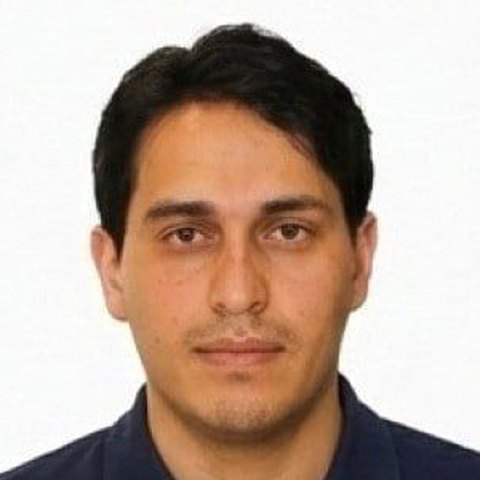
Hello! I'm Saeed Taghavi, a postdoctoral researcher in computational neuroscience at the Zapata-Briceño Institute of Neuroscience in Madrid. I hold a PhD in Physics with a thesis in theoretical neuroscience.
My research asks how timing shapes computation in neural networks: synchrony, oscillations, delays and plasticity, studied in spiking networks and in phase oscillator models. I also apply machine learning to brain data.
I am an engineer as well. Since 2020 I have built production systems, from Kubernetes and CI/CD for digital banking to embedded firmware and biosignal software. Today I build simulation and analysis pipelines for spiking-network and EEG studies.
Four sides of the work
01Spiking networks
02Phase oscillators
03Machine learning
04Engineering
01 · Science
Rhythms, delays and plasticity
Physics-first models of neural populations. I ask when networks synchronise, how external rhythms lock them, and how plasticity tunes the timing of their connections.
- Spiking networks
- Kuramoto models
- Mean-field models
- STDP
- tACS
- EEG
02 · Engineering
Infrastructure that runs research
Building production systems since 2020: Kubernetes and CI/CD for digital banking, embedded firmware, biosignal R&D. Today, simulation and analysis pipelines on HPC.
- Python
- C++
- NEST
- Kubernetes
- GitLab CI
- Slurm
- FastAPI
Research themes
All research →Rhythms and entrainment
Why some networks lock to an external rhythm and others resist. Weakly synchronised networks entrain to tACS over a wider band of frequencies.
Delays and plasticity
Spike-timing-dependent plasticity prunes connections with distributed conduction delays and keeps those that let activity propagate.
Synchrony on networks
Delay-coupled phase oscillators on rings form local synchrony and phase clusters. On 2D sheets, spiking networks carry travelling waves.
Noise as a resource
Stochastic resonance in Hodgkin-Huxley neurons and networks with delayed feedback, compared across six circuit motifs.
Latest
Jul 2026
Delay selection by STDP, in the Journal of Neuroscience
Plasticity selects the conduction delays that make a network efficient at transmitting signals. With A. Ghadiri, H. Rezaei, A. Aertsen, A. Kumar and A. Valizadeh.
Jun 2026
Inhibition sets the rhythm, in Physical Review Research
Inhibitory synaptic timescales drive transitions between oscillatory regimes in recurrent E–I networks.
2025
PhD in Physics, theoretical neuroscience
Thesis: Modeling the dynamics of excitatory-inhibitory networks and their response to alternating current stimulation. The LaTeX source, figures and build files are on GitHub.
2025
Tuning the brain rhythms, in Chaos, Solitons & Fractals
How a network's internal coherence decides how far tACS can entrain it. Code and data are open.
Software and tools
All software →tACS entrainment
GitHub ↗Simulations and analysis for the Chaos, Solitons & Fractals paper. AdEx E/I networks at three levels of baseline synchrony, driven across frequency and amplitude to map Arnold tongues.
kuramotoRing
GitHub ↗Phase oscillators on a ring, each coupled to its k nearest neighbours with distance-dependent delays. Local synchrony, phase clusters and how their number depends on the ring size.
computational-neuroscience.ir
Site ↗An open computational neuroscience textbook in Persian. Numerical methods for ODEs and SDEs, signal processing and nonlinear dynamics.
deep-learning-course
GitHub ↗One chapter per architecture for self-learners. LeNet on MNIST first, then AlexNet through to diffusion.
Distributed training on Kubernetes
GitHub ↗PyTorch DDP jobs on a kind cluster, scheduled by the Kubeflow Training Operator and launched from a FastAPI front end.
Contact